Implantation Bleeding Treatment in Bangalore
Spotting, or light bleeding, can be a common concern for women in the first trimester of pregnancy. For many women, this spotting is a normal occurrence, known as implantation bleeding. It is the process of the fertilized egg implanting in the lining of the uterus. You probably do not want to ignore any bleeding that is accompanied by other symptoms that you may be worried about.
At Revive Hospitals in Bangalore, Dr. Snehalatha Alapati is a warm and knowledgeable gynecologist who cares for women who have experienced bleeding in early pregnancy. She will help determine if the bleeding is normal implantation bleeding or something else that requires further evaluation.
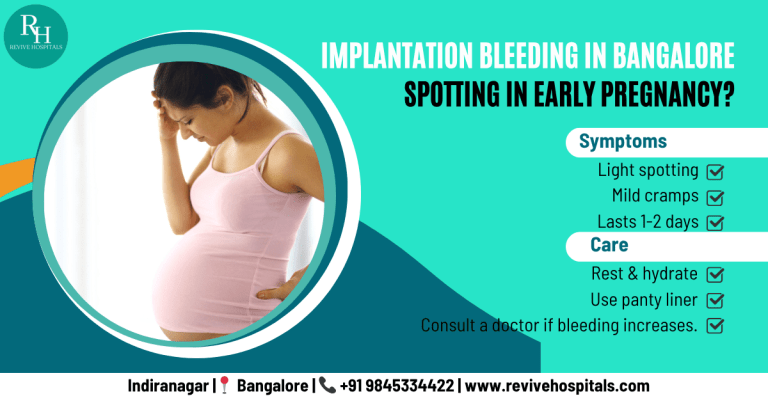
What is Implantation Bleeding?
Implantation bleeding is the small amount of spotting that some women have after the fertile egg is attached to the lining of the uterus. This typically occurs about 6 to 12 days after the egg is fertilized, and potentially at the same time as your next period, although it would last for a shorter time frame and would be lighter.
It is important to clarify that implantation bleeding is distinct from your regular period. The spotting simply refers to light bleeding that occurs due to small blood vessels along the wall of the uterus breaking off as the egg attaches to the uterus. The blood will be bright or light red or brown and will usually resolve on its own within one to two days.
For many women, implantation bleeding might not be alarming, as it is an indication of a very early pregnancy. Nevertheless, unless it is heavy and painful, there will usually be little cause for concern. If you experience light bleeding and suspect you are pregnant, you might want to confirm this with a gynecologist.
Symptoms of Implantation Bleeding
Women have very different bodies; however, there are often a few shared characteristics of implantation bleeding:
Light spotting: The blood is often brown, pink, or light red in color. Implantation bleeding is typically not heavy at all. Additionally, it is usually a lot lighter; a panty liner or very light pad is usually sufficient to contain the bleeding.
Duration: The bleeding typically lasts only a few days, usually no more than one to two days.
Mild cramps: You may sometimes locate some mild cramping in the lower abdominal area.
Additional symptoms: Before any other early pregnancy symptoms. Some women do report a little characterized mild fatigue, nausea, or breast tenderness.
Again, symptoms are mild or moderate and not generally anything that requires any treatment. But, if you are having a heavier flow, or it lasts longer than just a few days, you might want to get checked out for anything else (early pregnancy complications, or possibly even starting your period, etc.).
Key Differences Between Implantation Bleeding and Period
| Characteristic | Implantation Bleeding | Menstrual Period |
|---|---|---|
| Blood Flow | Implantation bleeding is light spotting that could occur while wiping only | Flow is typically heavier with a period. |
| Duration | Bleeding lasts one or two days. | A period usually lasts three to seven days. |
| Color of blood | Pink, brown, or light red | Bright red |
| Cramps | Implantation may cause mild discomfort. | Typically stronger and can cause similar back pain or bloating. |
| Timing | 6–12 days after ovulation | Regular period time |
Causes of Implantation Bleeding
Implantation bleeding refers to the bleeding that occurs when a fertilized egg embeds itself into the uterine lining. During the implantation process, the fertilized egg ruptures tiny blood vessels in the lining of the uterus, leading to a small amount of blood loss. Implantation bleeding is a normal process and occurs in nearly 1/3 of all pregnancies, and it is completely safe for both the mother and baby.
Implantation bleeding should only be brown or red-tinged spotting that does not become a heavy flow. It should not be accompanied by severe cramping, dizziness, or clots. If any of those symptoms do occur, it might indicate another pregnancy complication, such as a miscarriage or ectopic pregnancy, and you should contact your healthcare provider for further evaluation. If the bleeding is heavy or accompanied by any other symptoms, contact your doctor to evaluate for any of these complications.
When Does Implantation Bleeding Occur?
Implantation bleeding typically occurs within 6 to 12 days after conception has taken place, during which time the embryo has moved from the fallopian tube and has now implanted into the uterine wall.
Many women actually confuse this with a normal period; however, it occurs at a time that is very close to the expected date of menstruation. Typically, the bleeding will be less than, shorter than, or not as heavy as you would expect to see with a regular period.
If you suspect that you are pregnant and you start to see some light spotting during this time, you can take a pregnancy test or see a gynecologist in Bangalore for confirmation of suspected pregnancy.
Implantation Bleeding vs. Period
Although implantation bleeding may resemble menstrual bleeding, these two processes are different in the following ways:
Blood flow – Implantation bleeding is light spotting that may only occur when wiping. Your menstrual bleeding can be heavier.
Duration – Implantation bleeding lasts just one to two days, while your period lasts three to seven days.
Cramping – Implantation bleeding is typically associated with mild discomfort or pain, while cramps associated with menstruation are generally much more painful, and often, you may experience back pain or bloating.
Timing – Implant bleeding occurs about one week before your normal period.
If you are still unsure whether you are experiencing a period or implantation bleeding, it is usually best to see your doctor.
Treatment for Implantation Bleeding
Usually, no special treatment is necessary for implantation bleeding. It’s entirely normal during early pregnancy.
These are some simple self-care tips:
- Monitor your symptoms: Record how long the bleeding lasts, if the color changes, or if it is heavy or light.
- Rest: Try to avoid heavy lifting or hard activity until your spotting is complete.
- Avoid tampons or douching: You might consider a soft panty liner in your underwear.
- Drink plenty of fluids and eat healthy meals.
Arrange to see a doctor if:
- Your bleeding becomes excessive or lasts more than a few days.
- You have extreme abdominal pain or dizziness.
- You are not entirely confident that it is implantation bleeding, or have any other bleeding.
Dr. Snehalatha is a caring doctor at Revive Hospital in Bangalore who will not only care for you but also help explain what is causing the bleeding and care for both you and your baby.
When to Consult a Doctor for Implantation Bleeding
If the bleeding is heavy or lasts longer than a few days, contact your doctor. Implantation bleeding is usually brief and light, so if you are experiencing ongoing bleeding and it is increasing, you should be assessed by a physician soon. If you have significant cramping, fainting, or dizziness, or fever, these could be worsening symptoms you need to resolve quickly.
Women who have a history of miscarriage or ectopic pregnancy should contact their doctor right away if they experience any spotting or pain. The sooner you are assessed by a physician, the more reassurance you will have for yourself and your baby.
Dr. Snehalatha provides gentle and professional care at Revive Hospital. She offers individualized support for women experiencing early pregnancy bleeding. You will receive the proper guidance from her as to whether the bleeding is either normal or requires a plan to treat it. Do not ignore changes in your body during the early pregnancy.
Home Remedies for Managing Implantation Bleeding
If you are experiencing bleeding from implantation, basic home care can provide you with comfort and overall safety. Get plenty of rest and stay hydrated. Drink water, fresh-squeezed juices, or warm fluids so that your body can relax in early pregnancy.
If you experience cramping, you can apply a warm heat pack or compress to your lower abdomen. The warmth should help to less discomfort while relaxing your muscles. While you are managing the bleeding, do not do heavy work or strenuous exercise. You can perform light and gentle movement like walking slowly, but suggested to abstain from anything heavy lifting or straining your body.
Try a soft panty liner, so you can see the spotting easily. Be sure to note how long the spotting occurs and the color of the spotting. If your spotting becomes heavier or lasts for more than two days, see your doctor for a check-up
All of these are simply to help you manage implantation bleeding at home under care and comfort.
What to Remember About Implantation Bleeding
Implantation bleeding is typically acceptable because it indicates pregnancy status. However, remain aware of what is associated with your symptoms.
If you are experiencing severe pain or have heavy bleeding that lasts for longer than a couple of hours, you should call your gynecologist. Any time in doubt, you can call your gynecologist and make an appointment, just for peace of mind, and most importantly for safety. Dr Snehalatha at Revive Hospitals, Bangalore, provides practical advice regarding women’s health and individualised maternal care early in pregnancy to affirm your health and peace of mind.