Endometrial PRP – Treatment for Fertility in Bangalore
What is Endometrial PRP and How Can It Increase Fertility?
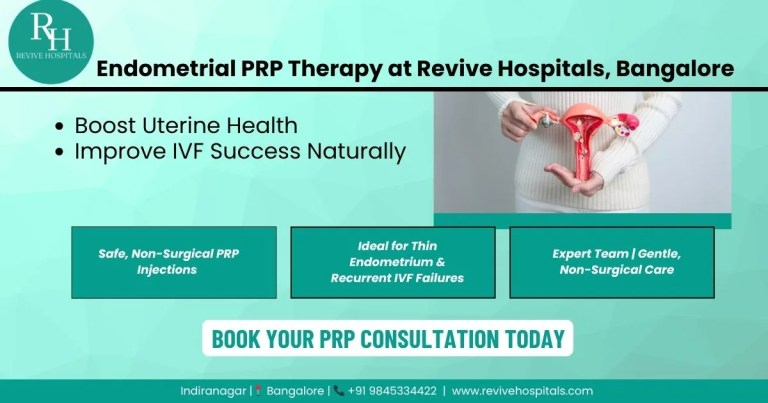
Endometrial platelet-rich plasma (PRP) therapy is a procedure that concentrates platelets from the patient’s blood and injects them into the endometrium, the lining of the uterus.
Platelet-rich plasma (PRP) infusions help to regenerate the endometrium by these infusions releasing growth factors, promoting cell proliferation, tissue repair and vascularization of the endometrial lining.
Endometrial platelet-rich plasma, or PRP, is used for thin endometrium because it has growth factors and cytokines that stimulate endometrial growth, blood flow and general receptiveness of the uterine lining for embryo implantation.
Who can Benefit from Endometrial PRP Treatment?
The likelihood of a successful embryo implantation and pregnancy may be decreased in women with thin endometrium’s (low endometrial thickness for embryo transfer).
It can be extremely difficult and emotionally draining to experience recurrent miscarriage (RPL) or repeated implantation failure (RIF) in IVF because of poor endometrial receptivity.
A healthy endometrium, or uterine lining, is essential for successful embryo implantation and pregnancy in women undergoing in vitro fertilisation (IVF). It is generally accepted that the optimal endometrial thickness for IVF is between 7 and 14 mm, with a thickness of at least 7 mm being essential for better results.
How Does Endometrial PRP improve Endometrial Thickness?
Women undergoing fertility treatments, especially those with thin endometrium or recurrent implantation failure, may benefit from Platelet-Rich Plasma (PRP) as a treatment to increase endometrial thickness and receptivity.
PRP treatment has been used to increase the thickness and receptivity of the endometrium. Mechanism: The ultrasound-guided injection of the uterine PRP, acts as a back end organotrophic response and vascularizing
With certain reports of mild to a significant rise in clinical pregnancy and live birth rates, PRP therapy seems to hold a promise for endometrial thickness restoration and pregnancy rate in women with thin endometrium.
Endometrial PRP vs Traditional Fertility Treatments
For women with thin lining or DOR, there is emerging data on the use of PRP (platelet-rich plasma) as an adjunct or replacement therapy for conventional fertility drugs or surgery.
There are many options for women who would rather not go under the knife that are worth considering – particularly for those who are anxious about invasive procedures, platelet-rich plasma (PRP) therapy presents a variety of benefits.
Results vary but endometrial PRP therapy shows at least some promise for improving IVF outcomes, particularly in women with thin uterus lining or recurrent implantation failures. Pregnancy and live birth rates have lagged behind significantly in some studies, but not in others.
What to Expect from Endometrial PRP Treatment
Pre-treatment consultation – To determine the possibility of PRP treatment for patients with thin endometrium or a very early recurrent miscarriage.
The PRP procedure – In order to potentially increase endometrial thickness and receptivity for embryo implantation, platelet-rich plasma (PRP) therapy for the uterus entails taking a patient’s blood, processing it to concentrate platelets, and then injecting the PRP into the uterine lining.
Post-treatment care – post-treatment care after endometrial treatment includes managing recovery, keeping track of endometrial improvement, and scheduling follow-up visits.
Success Stories and Patient Testimonials for Endometrial PRP at Revive Hospitals
The search results do not include actual patient reviews of Revive Hospital specifically, but other studies have found that PRP (Platelet-Rich Plasma) therapy can improve fertility outcomes for women with conditions like poor ovarian reserve (POR) and untimely ovarian failure (POF).
Although the search results do not include specific Revive Hospital success stories, PRP treatment for endometrial thickening and increasing implantation rates has produced favourable results in other clinics.
Because it may improve egg quality and enhance embryo implantation, platelet-rich plasma (PRP) therapy is becoming a promising supplemental fertility treatment, especially for women undergoing IVF. Physicians are investigating the potential of PRP to treat conditions such as recurrent implantation failure, thin endometrial lining, and low ovarian reserve.
Why Choose Revive Hospitals for Endometrial PRP Treatment in Bangalore?
Bangalore’s Revive Hospitals are a good choice for endometrial PRP treatment because of their dedication to ethical practices, skilled medical staff, and emphasis on patient care.
The focus is on maximizing the therapeutic benefits of PRP, whether for hair restoration, skin rejuvenation, or other applications. The focus is on maximizing the therapeutic benefits of PRP, whether for hair restoration, skin rejuvenation, or other applications.
You can anticipate personalised care and attention at Revive Hospitals that covers the full patient experience, not just the medical treatment.
Book your consultation
“Struggling with thin endometrium or recurrent miscarriage? eBook your session with Revive Hospitals nowadays for expert care and customized endometrial PRP treatment.”