Abnormal Uterine Bleeding (AUB) Treatment in Bangalore
Periods are supposed to have a rhythm. Not always predictable to the last hour, sure, but most women know their cycle well enough to sense when something feels “off.” So when you suddenly start spotting between cycles, or your period feels heavier than usual, or the flow just refuses to stop — it’s worth paying attention.
Doctors call this Abnormal Uterine Bleeding (AUB). And while the term may sound heavy, the reality is that it’s surprisingly common — more women deal with it than you might imagine. At Revive Hospital, Bangalore, we’ve seen a growing number of young women walking in with these concerns, often unsure whether they’re overthinking or if it’s really something to be checked. The short answer: if it keeps happening, don’t brush it aside.In endometriosis, tissue that resembles the lining of the uterus grows outside of it, causing pain, inflammation, and possibly infertility. Despite not being cancerous, this tissue can lead to pain, scarring, and problems like ovarian cysts or blocked fallopian tubes, which can affect fertility.
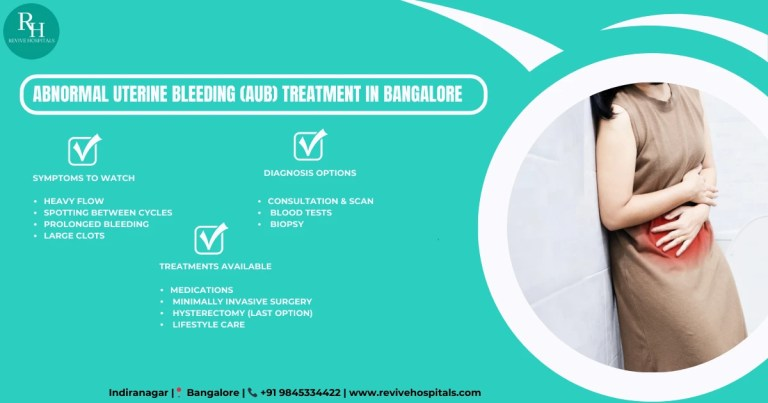
What is Abnormal Uterine Bleeding (AUB)?
Abnormal Uterine Bleeding refers to an unexpected uterine bleeding that is either outside the menstrual cycle or even heavy flow during the cycle. It is a common symptom in many women that impacts daily life and makes even everyday chores difficult.
AUB is a broad term that refers to various irregularities in the menstrual cycle, such as frequency, duration, regularity, volume of flow, etc. Women can experience acute or chronic bleeding.
What are the Common Symptoms of Abnormal Uterine Bleeding?
Women who are dealing with AUB can notice different types of symptoms. Here are a few common symptoms of AUB that you must not ignore:
- Frequent spotting or bleeding between menstrual cycles.
- Prolonged or unusually heavy flow during the menstrual cycle.
- Frequent bleeding after sexual intercourse.
- Spotting or bleeding after menopause.
- Passage of large blood clots.
If you are noticing any of these symptoms or any other such irregularities in your menstrual cycle, you must consult a doctor at the Revive Hospital, Bangalore.
What are the Causes of AUB?
Abnormal Uterine Bleeding can be due to various reasons that are broadly categorised as structural and non-structural causes.
Structural causes often include:
- Uterine Fibroids: These are probably the most common causes of AUB. These are benign muscle growth in the uterus that can lead to irregularities in the menstrual cycle.
- Endometrial Polyps: Polyps or Endometrial Polyps refer to a focal outgrowth of tissues that can affect the menstrual cycle. In some cases, Polyps can carry a risk of malignancy.
- Adenomyosis: Adenomyosis occurs due to the formation of endometrial tissue in the uterine muscle. This can impact the menstrual cycle significantly.
Non-structural causes can be a little more layered:
- Systematic Bleeding Disorders: There are different types of systemic bleeding disorders that many women experience that might lead to AUB.
- Ovulatory Dysfunction: Polycystic ovary syndrome (PCOS), thyroid dysfunction, etc, can also impact the menstrual cycle, leading to AUB.
- Medications: Certain medications can impact the hormones in the body, resulting in women experiencing AUB.
Note: These are only some common symptoms that many women go through. Apart from this, if you experience any other such irregularities in your periods, you must get a diagnosis.
Getting the Right Diagnosis of Abnormal Uterine Bleeding
If you have been experiencing abnormal bleeding in your uterus, it is important to consult a doctor for a careful diagnosis. In most cases, the diagnosis is made by the following methods:
Physical and Medical Examination
A physical and medical examination is conducted to understand the menstrual cycle changes and underlying conditions that might lead to AUB. It usually includes a consultation with the doctor where you are asked about your menstrual cycle and your family’s medical history.
Imaging Tests
Pelvic Ultrasound: Pelvic ultrasound is done to check the formation of fibroids, polyps, thickening of the uterus lining, and other related structural abnormalities.
MRI: MRI is done in certain cases to get a detailed image.
Laboratory Tests
Laboratory tests usually include taking blood samples to check blood count, clotting profile, hormonal levels, etc.
Tissue Sampling
- Hysteroscopy: This is done to identify any abnormalities in the uterine cavity.
- Endometrial Biopsy: This is usually performed in cases when cancer might be an underlying reason.
Abnormal Uterine Bleeding: Treatment Options to Explore
The good news? AUB is treatable, and often with far less intervention than most women assume. There are different types of treatment options available for abnormal uterine bleeding, depending on the underlying causes of the condition. Here are some treatment options for AUB:
Medications
Medications are suggested to many women depending on factors like their age, health and the line condition for AUB.AUB medications can be broadly categorised as hormonal and non-hormonal medications. Some common types of medications include Oral Contraceptive Pills, hormonal IUDS, Progesterone Therapy, and Iron Supplements.
Surgical
- AUB can be treated surgically as well. There are some minimally invasive procedures, such as:
- Uterine Fibroid Embolisation: This is a minimally invasive procedure performed primarily to treat fibroids. Under this, tiny particles are injected into the blood vessels supplying the fibroid, which results in the fibroid shrinking.
- Hysteroscopic Procedures: This is performed by inserting a thin device through the cervix, known as the hysteroscope. This helps remove fibroids and polyps by targeting the specific areas in which they are growing.
- Myomectomy : Myomectomy is a common type of surgery performed primarily to remove fibroids without impacting the uterus. This type of surgery helps preserve fertility as well.
- Hysterectomy : This is a major surgery typically performed only in conditions when other treatments have failed to treat a certain specific type of AUB. Under this, the uterus is completely removed.
Lifestyle Changes
- Women facing acute AUB may also be advised to make some lifestyle modifications, such as eating a balanced diet, managing their weight, and engaging in regular physical activities.
Why is Revive Hospital the Right Choice?
At Revive, we believe no woman should have to schedule her life around unpredictable bleeding. Our team takes the time to walk you through every step — from diagnosis to treatment options. Safety, comfort, and privacy are non-negotiables here.
If you’ve been noticing changes in your cycle, don’t ignore them. Abnormal doesn’t always mean dangerous, but it does mean worth checking. The sooner you understand what’s happening inside your body, the faster you can get back to living without second-guessing every spot or stain.
Book a consultation at Revive Hospital, Bangalore — and let’s take the uncertainty out of your cycle.